
Malayan Tapirs of the Khlong Saeng–Khao Sok Forest
KHLONG SAENG · MALAYAN TAPIR
Malayan Tapirs of the Khlong Saeng–Khao Sok Forest
Malayan tapirs are scientifically documented in Khlong Saeng and remain a focus of modern camera-trap research in the wider Khlong Saeng–Khao Sok Forest Complex. They are secretive forest mammals and should not be presented as a likely tourist sighting.
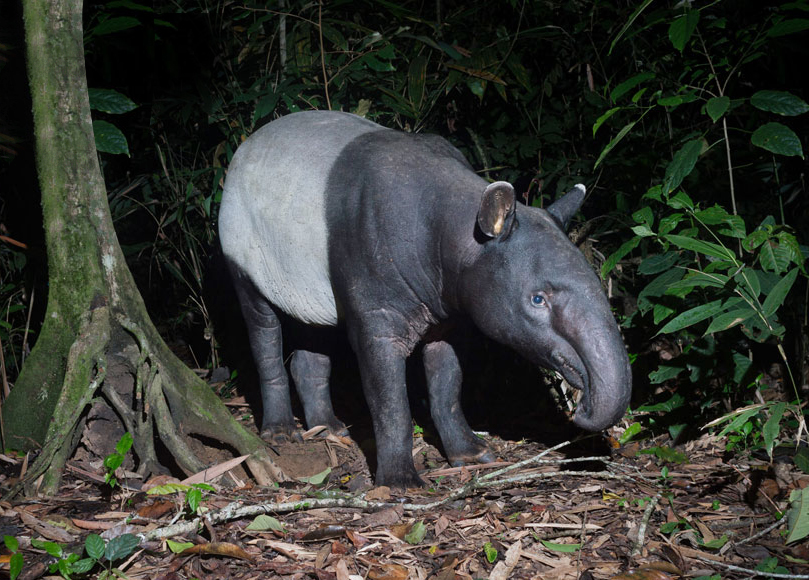
Malayan tapir recorded by a wildlife camera trap in Khao Sok. Tapirs are secretive forest mammals and direct sightings are exceptionally rare.
A Long Research History
Older Khlong Saeng studies documented tapirs through tracks, field surveys and camera trapping, and Thai academic work specifically examined tapir habitat use in the sanctuary.
2026 Camera-Trap Research
A 2026 study in the wider Khlong Saeng–Khao Sok Forest Complex used camera-trap bycatch data to investigate tapir abundance and ecology. From 91 detections, researchers identified a minimum of 43 individuals in their dataset and modelled abundance and density for the study area.
What the Numbers Do Not Mean
The study does not mean that 43 tapirs live beside tourist boat routes, nor that the number represents the entire forest complex. Camera placement, survey area, statistical assumptions and detection probability all matter. Population estimates must remain attached to the research scope in which they were produced.
Why Visitors Rarely See Them
Tapirs are primarily forest animals and can move through dense vegetation away from open shorelines. Their presence may be recorded repeatedly by cameras while remaining almost invisible to ordinary visitors.
Why Their Presence Matters
Tapir research demonstrates the value of large connected protected landscapes. Maintaining forest continuity is essential for wide-ranging and threatened mammals that cannot persist in tiny isolated fragments.
How We Talk About Tapirs
Khao Sok Travel treats tapirs as part of the conservation story of Khlong Saeng, not as a promised attraction. If a visitor ever sees one, it should be understood as an exceptional wild encounter.
KEY FACTS
GOOD TO KNOW
Species: Malayan/Asian tapir (Tapirus indicus) | Evidence: historic surveys + dedicated research + 2026 camera-trap analysis | Visibility: very low for ordinary visitors | Interpretation: conservation species, not a sighting promise
The 2026 research concerns the wider Khlong Saeng–Khao Sok Forest Complex and a defined camera-trap study design. Do not convert study estimates into a sanctuary-wide tourist population claim.
Frequently Asked Questions
Are Malayan tapirs found in Khlong Saeng?
Yes. They have been documented by historical surveys and modern camera-trap research in the wider forest complex.
Can tourists expect to see a tapir?
No. Tapirs are secretive forest mammals and a sighting would be exceptional.
What did the 2026 study find?
Researchers analysed 91 camera-trap detections and identified at least 43 individuals in their dataset, then used statistical models to estimate abundance and density within the study framework.
Does that mean there are only 43 tapirs?
No. The figure is the minimum number of individually identified animals in that dataset, not a total population count for Khlong Saeng.
Why study tapirs with camera traps?
Camera traps can repeatedly sample secretive animals without requiring direct human observation and allow researchers to analyse occurrence, individual identity and ecological patterns.